Mentoring Isn't a Perk. It's Infrastructure.
The 6 Rs of lasting mentoring
No company asks whether its people need a laptop. Nobody runs a pilot to check if email pays for itself. These things are infrastructure. They are funded because the company's goals cannot be met without them.
At many companies, the idea of mentoring is unheard of. Those that know it treat it as a perk. It gets a launch event, a few busy months, and then it slips off the agenda the first time budgets get tight. This happens again and again in our careers.
At MentoringIn, we believe a mentoring program is not a nice-to-have benefit. Without one, companies can lose millions of dollars. When people have no mentorship, their progress stalls. Some leave, some burn out, and others stop caring. The company pays for each of these every day. Nobody sees the full cost, because it is split across HR, finance and every team.
To make this loss visible, MentoringIn built a model that shows the impact of mentoring on a company's business: the MentoringIn Cost of No Guidance Model™. It uses available data from Gallup and the US Bureau of Labor Statistics. Here is what it shows.
The cost of no one to ask
Every company has a Guidance Gap: the people who have no one to turn to when work gets hard. In the US, surveys suggest about half of workers do not have a mentor.
The gap does not show up as a line in the budget. It shows up as four things every leader already worries about.
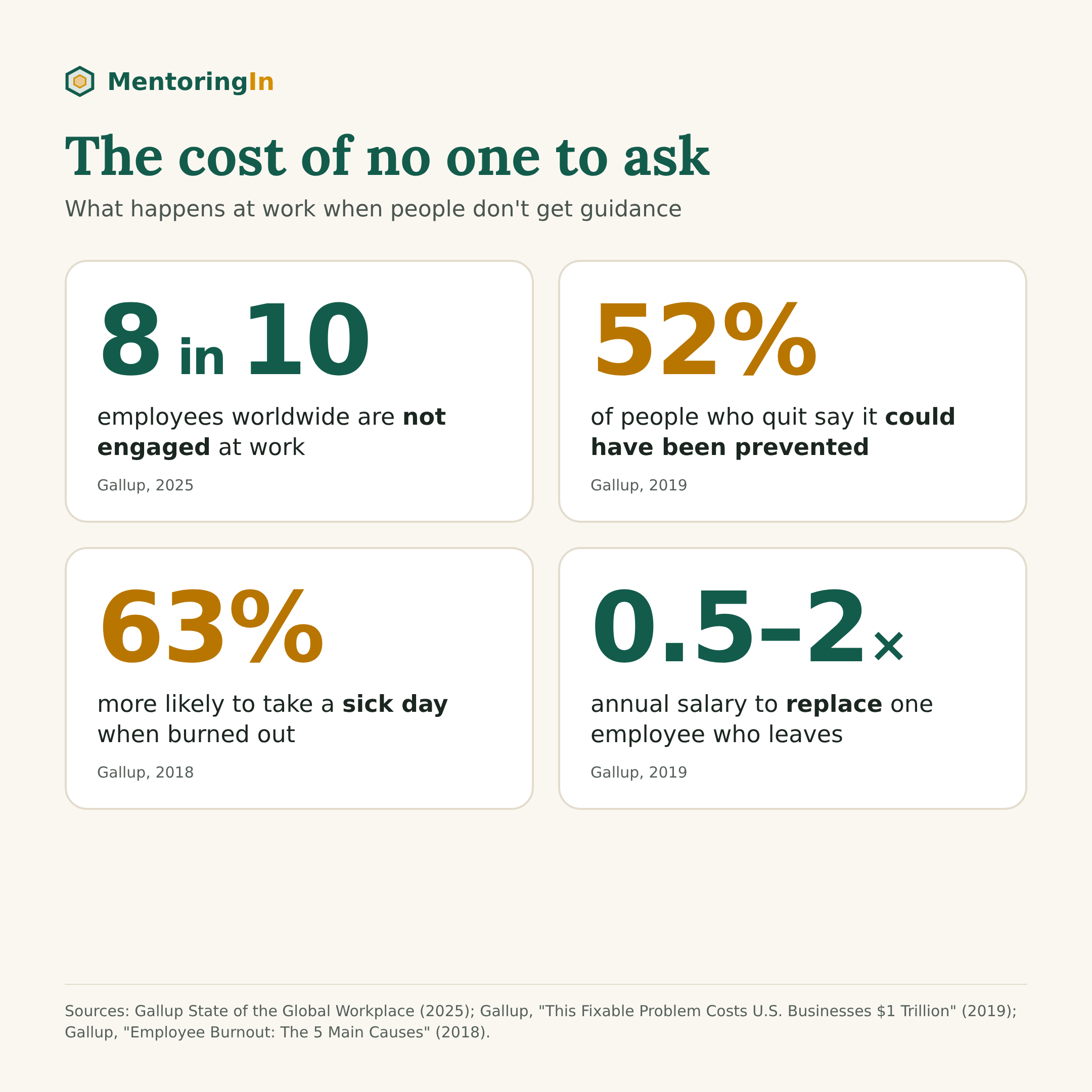
The number that stays with us is 52%. More than half the people who quit said their manager or company could have done something to keep them. Many of those people did not have to go. Someone simply was not there when it mattered.
What changes when someone is there
The research on mentoring is not new, and it points the same way every time. People with a mentor stay longer, see a future for themselves and feel valued.
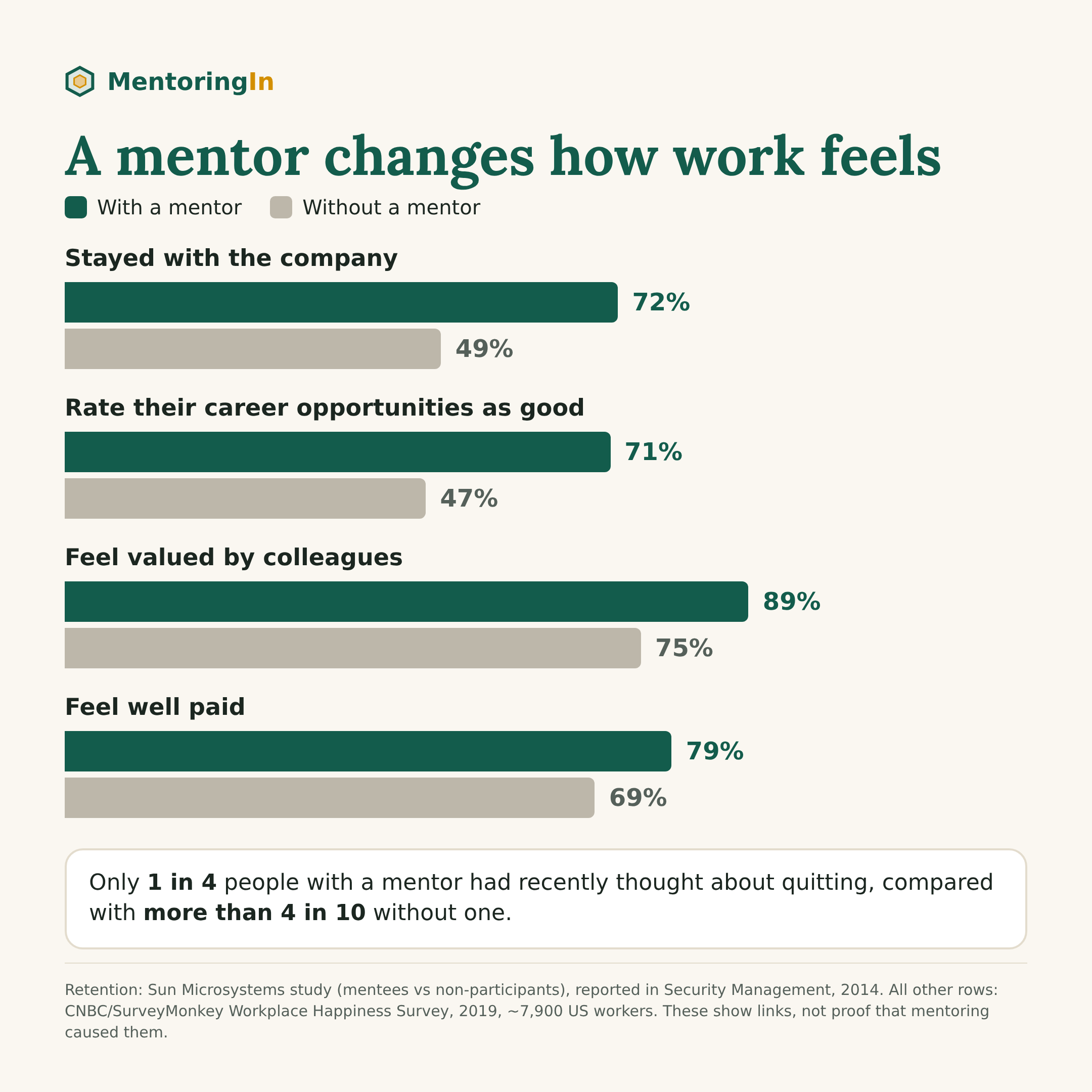
These are links, not proof. People who find mentors may already be more engaged. That is exactly why we built the model to be cautious, and why we count only a small part of these differences as the effect of mentoring.
What mentoring gives back
The model looks at three things mentoring changes. We call them the MentoringIn Effect Factors, and each one comes from a side of our Growth Hexagon:
- Commitment: fewer people leave who did not need to.
- Circle: fewer people burn out, so fewer sick days.
- Calling: some people who had checked out start to care again.
Take a 1,000-person pharmaceutical company in the US. Half its people have no mentor. The company mentors 200 of them, using its own experienced staff, with one 30-minute call a month.
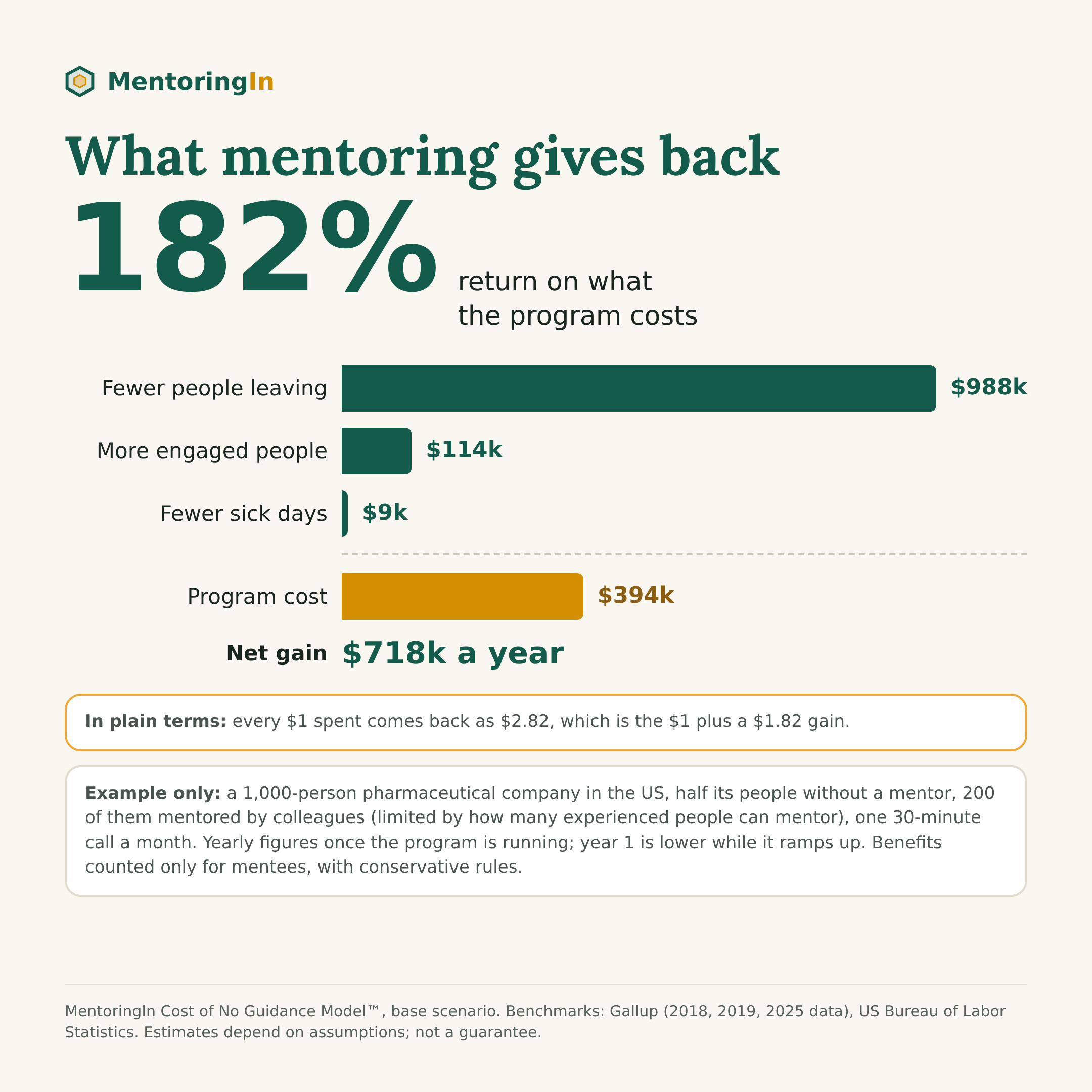
Once the program is running, it returns about 182% on what it costs. Every $1 spent comes back as $2.82. Most of that comes from people who stay.
We tried hard not to oversell this. The model counts only exits that could have been prevented. It counts the time of every mentor and mentee as a cost. It assumes the first year delivers only half the effect. And if mentoring works only half as well as the base case, the program roughly breaks even. It does not lose much, and it does not need heroics to pay off.
Bigger companies gain more
The larger the company, the better each dollar works. A big company already has HR systems, learning platforms and people who can coordinate a program. It has a deeper pool of experienced people, so mentees find better matches. Good habits spread faster across a large network.
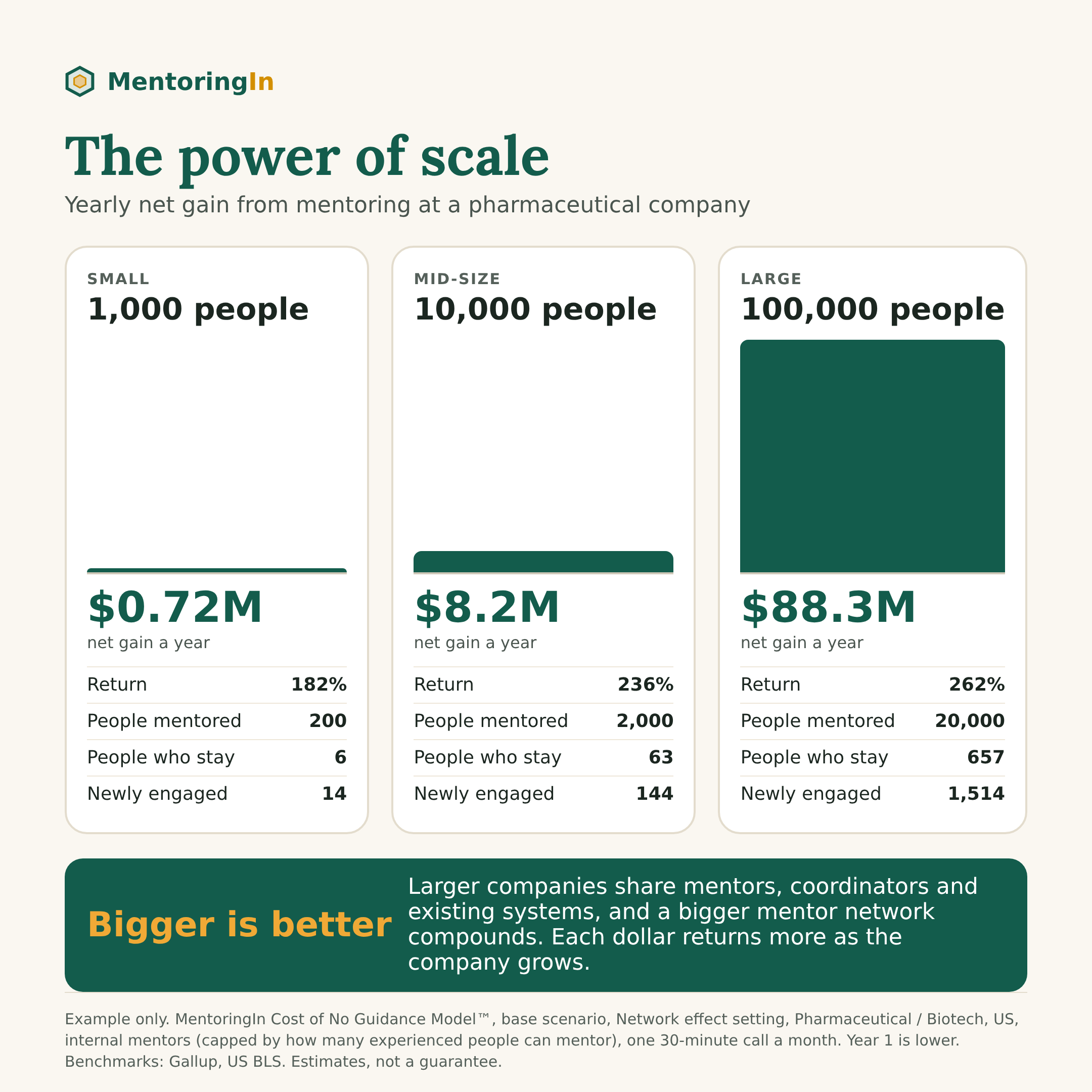
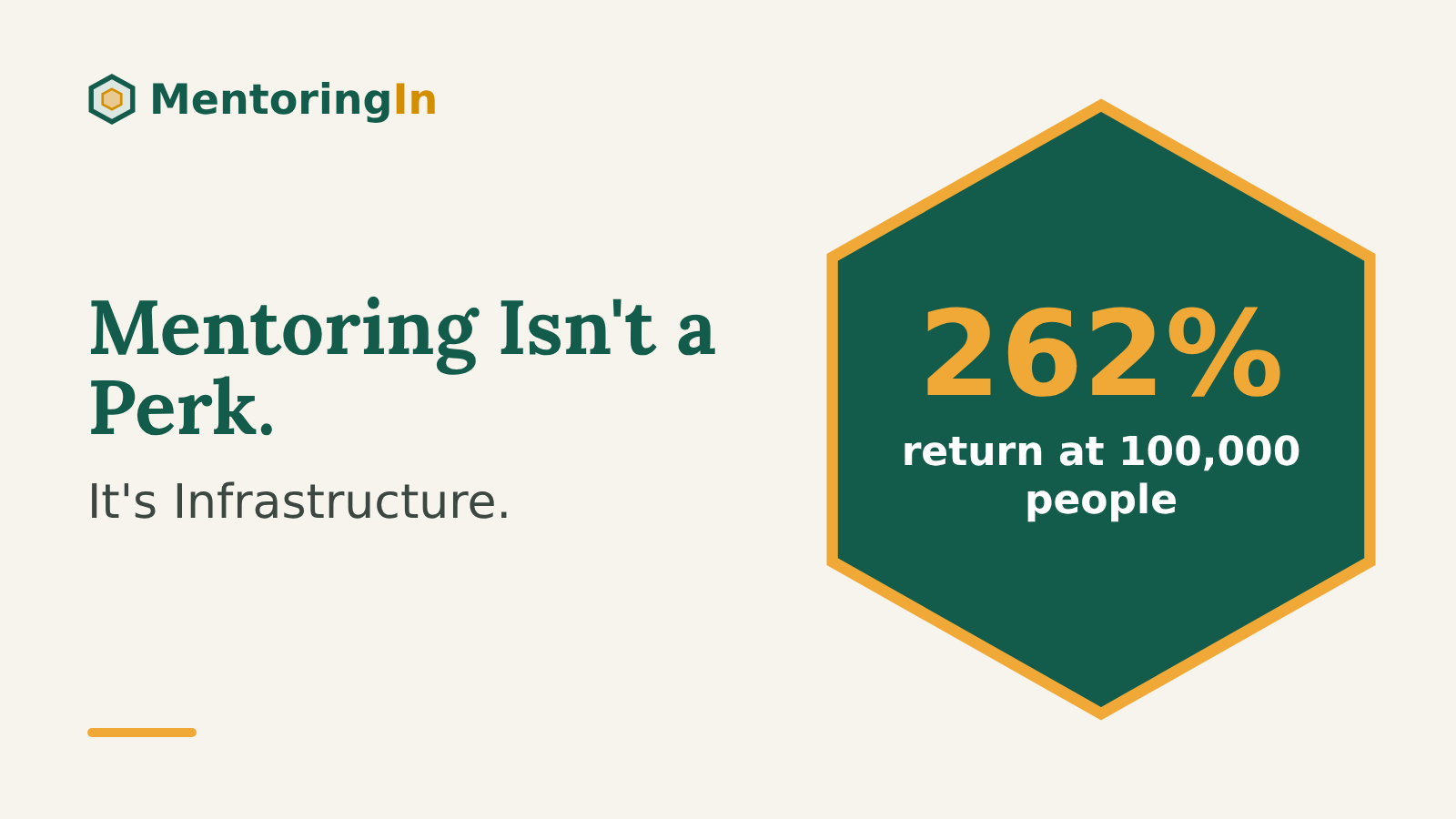
At 100,000 people, the same program returns about 262%, or roughly $88 million a year. That is after counting about $34 million a year in costs, including every hour mentors and mentees spend on it.
The gain is not unlimited. Most of the value still comes from one person helping another, and size cannot multiply that much. But the direction is clear. The companies best placed to run mentoring well are often the ones treating it as optional.
Why programs still fail, and what makes them last
If the numbers are this good, why do so many mentoring programs fade? We wrote about this in The Six F's: Why Corporate Mentoring Programs Quietly Fail. In short, most programs are built like events, not like infrastructure. Mentors get too many mentees. Big titles get picked over real experience. The program depends on one champion, and when that person moves on, it quietly stops.
Infrastructure is built differently. It is light enough to run every month without anyone pushing it. At MentoringIn, we call what that takes the 6 Rs of lasting mentoring:
- Rhythm. Keep it small: one 15 to 30 minute call a month, with one or two mentees per mentor. People can keep that up for years.
- Relevance. Match on lived experience, not titles. The best mentor is often someone who faced the same problem two years ago, not the most senior person in the room.
- Respect. People open up only when they know there is no judgment and no report back to their manager. We call these the six NOs in Safe to Say It.
- Roadmap. A shared framework helps both sides know what they are working on. Ours is the MentoringIn 6C Framework.
- Results. Measure it like any other system. Track who stays, sick days and engagement for mentees against everyone else, every year.
- Resources. Fund it as a budget line, not a pilot. A pilot asks whether it works. A budget line says it is how the company runs.
5-Year Mentorship Sustainability Plan
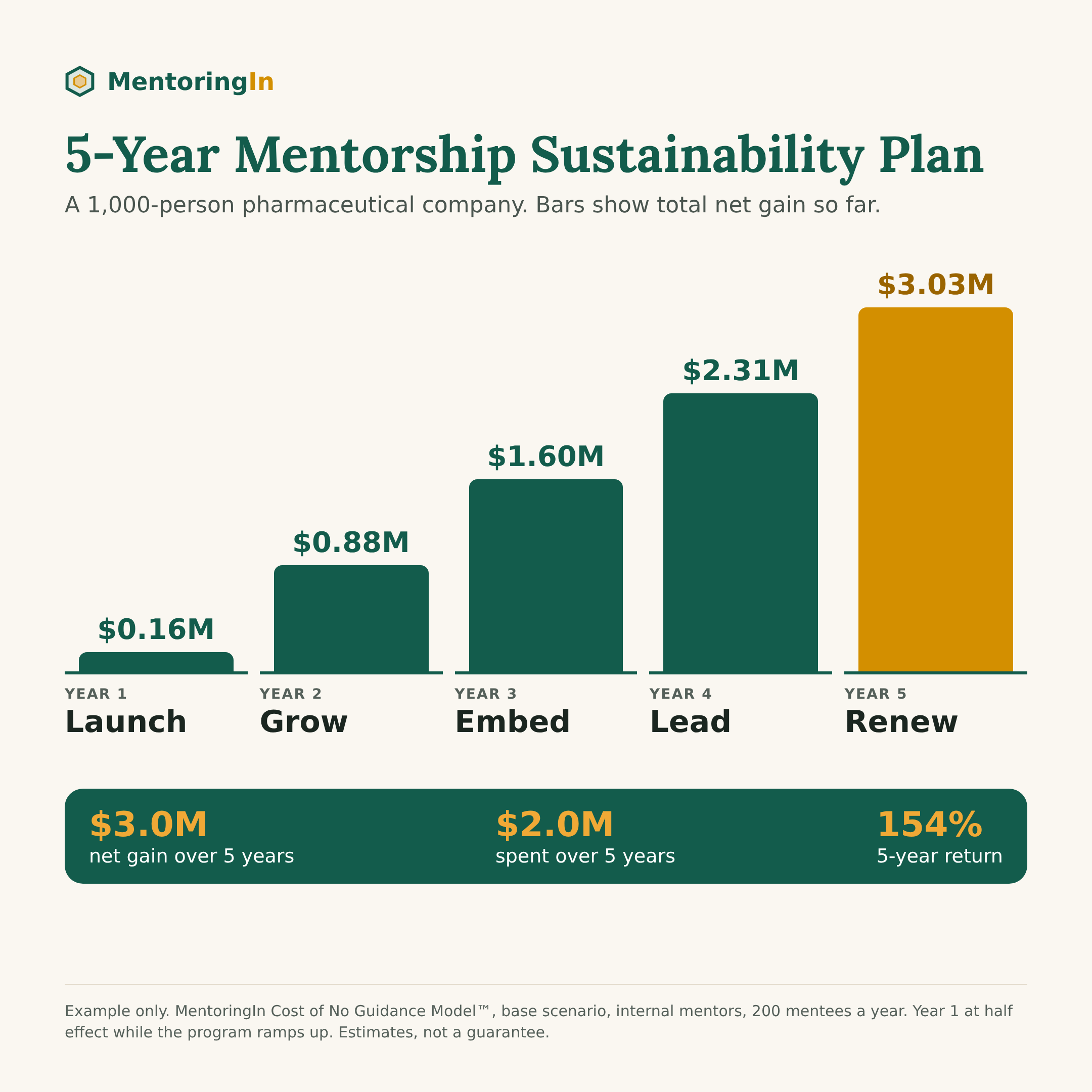
Starting a program is easy. Keeping it alive for five years is the hard part. Each year has one job, and the gain builds every year:
| Stage | What the company does | Sign it is working |
|---|---|---|
| Year 1: Launch | Start with one or two groups, such as new hires or people returning to work. Match 200 mentees with 100 mentors on lived experience. Brief mentors in 30 minutes on the six NOs. Check every pair at month 3 and rematch without blame. Record a baseline of exits, sick days and engagement. | Most pairs still meeting at month 6 |
| Year 2: Grow | Invite year 1 mentees to mentor someone newer. Add a second group. Make the coordinator a named role, about a quarter of one person's time. Share the first yearly report with leaders. | Mentees stay longer than others |
| Year 3: Embed | Offer a mentor at onboarding, after a promotion and on return from leave. Count mentoring time in goals and reviews. Name a senior sponsor. | Mentoring is part of normal HR steps, not a separate event |
| Year 4: Lead | Recognise mentors in tiers and let them share it on LinkedIn. Recruit mentors from every function and site. Experienced mentors guide new ones. | Every function has mentors |
| Year 5: Renew | Report five years of results in dollars. Ask mentors and mentees what to change. Refresh matches and the 6C framework. Set goals for the next five years. | Mentoring is a standing budget line |
From perk to requirement
Right now, someone talented in your company is deciding whether to stay. One honest conversation could keep them. Without a mentor, that conversation never happens.
Now multiply that across your Guidance Gap. A 1,000-person company leaves about $718,000 a year on the table. At 100,000 people, $88 million. Every year. No alarm goes off. No budget line shows it. You would shut down a plant that leaked that much. You would never open a lab without safety training. Yet half your people go to work every day with no one to share with, speak openly to, or learn from.
Here is the uncomfortable test. Walk your floor tomorrow and count the people who would leave if one more thing went wrong. Each of them is a bill you have not received yet. Send us your headcount, and we will show you how big that bill is.
Mentoring isn't a perk. It's infrastructure. Build it before your best people walk out the door.
Figures are estimates from the MentoringIn Cost of No Guidance Model™, base scenario, and depend on assumptions. They are not a guarantee. Benchmarks: Gallup, State of the Global Workplace; Gallup, This Fixable Problem Costs U.S. Businesses $1 Trillion; Gallup, Employee Burnout; CNBC/SurveyMonkey Workplace Happiness Survey; US Bureau of Labor Statistics, JOLTS.