Six Sides of Growth: The MentoringIn 6C Framework
One six-sided map for every mentoring conversation
Why six Cs
The 6C framework gives every MentoringIn conversation the same six-sided map as the Growth Hexagon, so mentor and mentee always know which side they are strengthening.
Many mentoring programs use a 5C model. One widely used version walks a single problem through Challenges, Choices, Consequences, Creative solutions and Conclusions. It works well for one decision at a time. It does not show where a person stands overall, so the mentor cannot tell which problem matters most.
The 6Cs keep that problem-solving spirit and add the whole-life view MentoringIn stands for: each C is one side of the Hexagon. A mentee's two lowest sides, their growth edges, decide which Cs the mentorship focuses on first.
The 6Cs at a glance
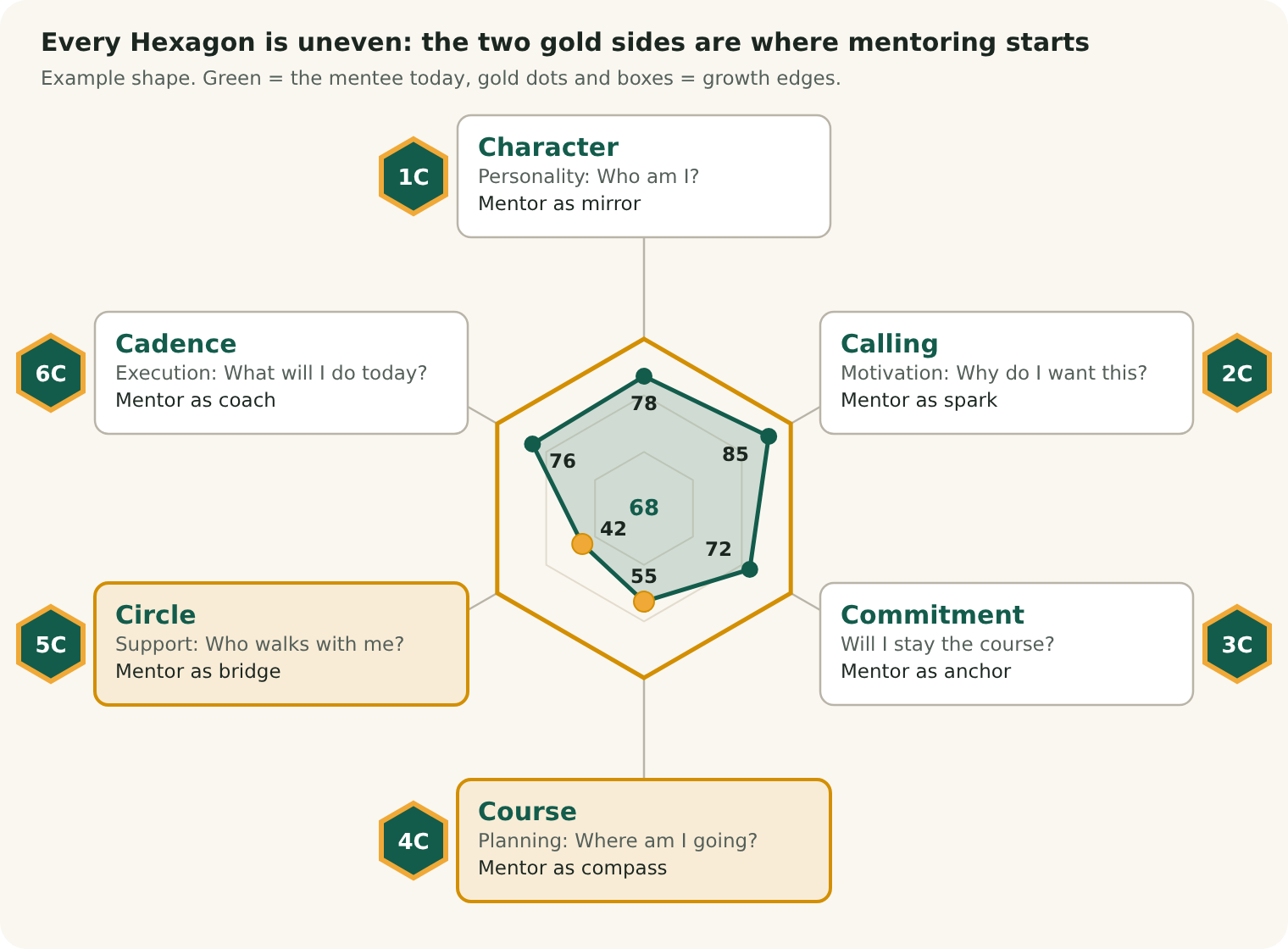
The six Cs are Character, Calling, Commitment, Course, Circle and Cadence. Each one sits on its matching Hexagon side and gives the mentor a role.
The six Cs in depth
Each C gives the mentor a role, a few questions to open with, the signs that side is weak, and actions that strengthen it.
1. Character: Who am I?

- Signs it is weak: copying others' paths; unsure what they are good at; saying yes to everything.
- Mentor asks: When do you feel most like yourself at work or at home? What do people come to you for? Which values would you never trade?
- Actions: list three strengths with a real example of each; ask two trusted people for honest feedback; name one value to protect this month.
2. Calling: Why do I want this?

- Signs it is weak: working hard but feeling empty; chasing goals set by others; burnout.
- Mentor asks: If this worked out, what would change in your life? Whose expectation is this goal really? What energizes you, and what drains you?
- Actions: write the goal in one sentence starting with "Because"; track energy highs and lows for one week; drop or delegate one draining task.
3. Commitment: Will I stay the course?

- Signs it is weak: many starts, few finishes; plans dropped after setbacks; guilt about past attempts.
- Mentor asks: What has made you give up before? How much time can you honestly give this each week? What will you do when a week goes wrong?
- Actions: set one small weekly promise; plan the restart for a missed week; share progress with the mentor before each call.
4. Course: Where am I going?

- Signs it is weak: "I'm not growing" with no picture of what growth means; no 12-month goal; reacting instead of choosing.
- Mentor asks: Where do you want to be in 12 months? What is the next milestone in 90 days? What are you choosing not to do?
- Actions: write a 12-month goal and a 90-day milestone; agree up to three shared goals; review the plan at every monthly call.
5. Circle: Who walks with me?

- Signs it is weak: carrying everything alone; no one to ask at work; isolation after a move, a career break or becoming a parent.
- Mentor asks: Who knows what you are working toward? Who could open a door for you? Where can you ask for help without worry?
- Actions: name three people for the circle (a peer, a sponsor, a friend); have one honest conversation at home about support; join a MentoringIn circle.
6. Cadence: What will I do today?

- Signs it is weak: overworked but not moving forward; busy days with no progress on what matters; no time to sharpen the saw.
- Mentor asks: What will you do this week toward your goal? What can you stop doing? When is your protected time?
- Actions: block one protected hour a week; pick one habit to practise for 30 days; end each week by noting one step taken.
How a mentorship runs
A mentorship lasts 3 to 6 months, with one call a month of 15 to 30 minutes, and focuses on the mentee's two growth edges.
- Before the first call: the mentee takes the Growth Hexagon. Mentor and mentee both see the shape and the two lowest sides.
- First call, map the shape: get to know each other, talk through the Hexagon, and agree which two Cs to work on first and up to three shared goals.
- Each monthly call, one C at a time: check in on last month's step, explore one C with its questions, and agree one small action for the next month.
- Between calls: short messages are welcome. Replies within a few days, not instantly.
- Midpoint (about month 3): the mentee retakes the Hexagon. Celebrate what moved and decide whether to switch to a different C.
- Closing call: look back at the starting and current shapes, name what changed, and agree how the mentee keeps going alone. Many mentees then pay it forward as mentors.
More than one mentor
A mentee can work with more than one mentor at the same time, each on a different C. For example, one mentor guides Course (where your career is going) while another helps with Circle (support at home as a working parent). Each mentorship follows the same monthly rhythm, and mentors only share notes with each other if the mentee agrees.
Mentor guidelines
Mentors share lived and professional experience in a safe space without judgment. They guide; they do not decide for the mentee.
- Listen first. Spend more of the call listening than talking. Ask before advising.
- No judgment. Mentees bring things they cannot say at work. Never criticize, gossip or compare them to others.
- Keep it confidential. What a mentee shares stays between you, unless someone's safety is at risk.
- Share experience, not instructions. Say "what worked for me was..." rather than "you should...". The mentee makes their own choices.
- Stay within your experience. Peer support is not therapy, legal, medical or financial advice, unless you list a verified license.
- Never sell. No services, products, jobs or investments to a mentee, inside or outside MentoringIn.
- Keep the rhythm. One call a month, 15 to 30 minutes. Reply to messages within a few days, and tell your mentee early if you need to pause.
- Respect boundaries. Keep the relationship professional and respectful. Report anything that makes you uncomfortable.
- Know when to refer. If a mentee mentions crisis, self-harm or danger, encourage them to call or text 988 in the US or contact local emergency services, and tell MentoringIn.
Mentee guidelines
Mentees get the most when they come prepared, stay honest and own their next step.
- Come with one question. Before each call, write down the one thing you most want to talk about.
- Be honest. This is a safe place. The more real you are, the more your mentor can help.
- Own your actions. Your mentor guides; you decide and do. Share what happened with last month's step.
- Respect their time. Be on time, keep calls to the agreed length, and give notice if you need to reschedule.
- Keep it confidential too. What your mentor shares about their own life stays with you.
- Give feedback. If the match is not working, tell your mentor or MentoringIn. A change is fine.
- Pay it forward. When you have grown, consider guiding someone who stands where you once stood.